- This event has passed.
September 19 @ 7:00 pm - 10:00 pm
One of MMoCA’s newest exhibitions is already prompting conversation across Madison’s art community. Diffuse Control, by Wisconsin-native digital artist Beeple, arrives at a moment when artists, museums, collectors, and the public are wrestling with a complicated question: What happens to art when artificial intelligence becomes part of the creative process?
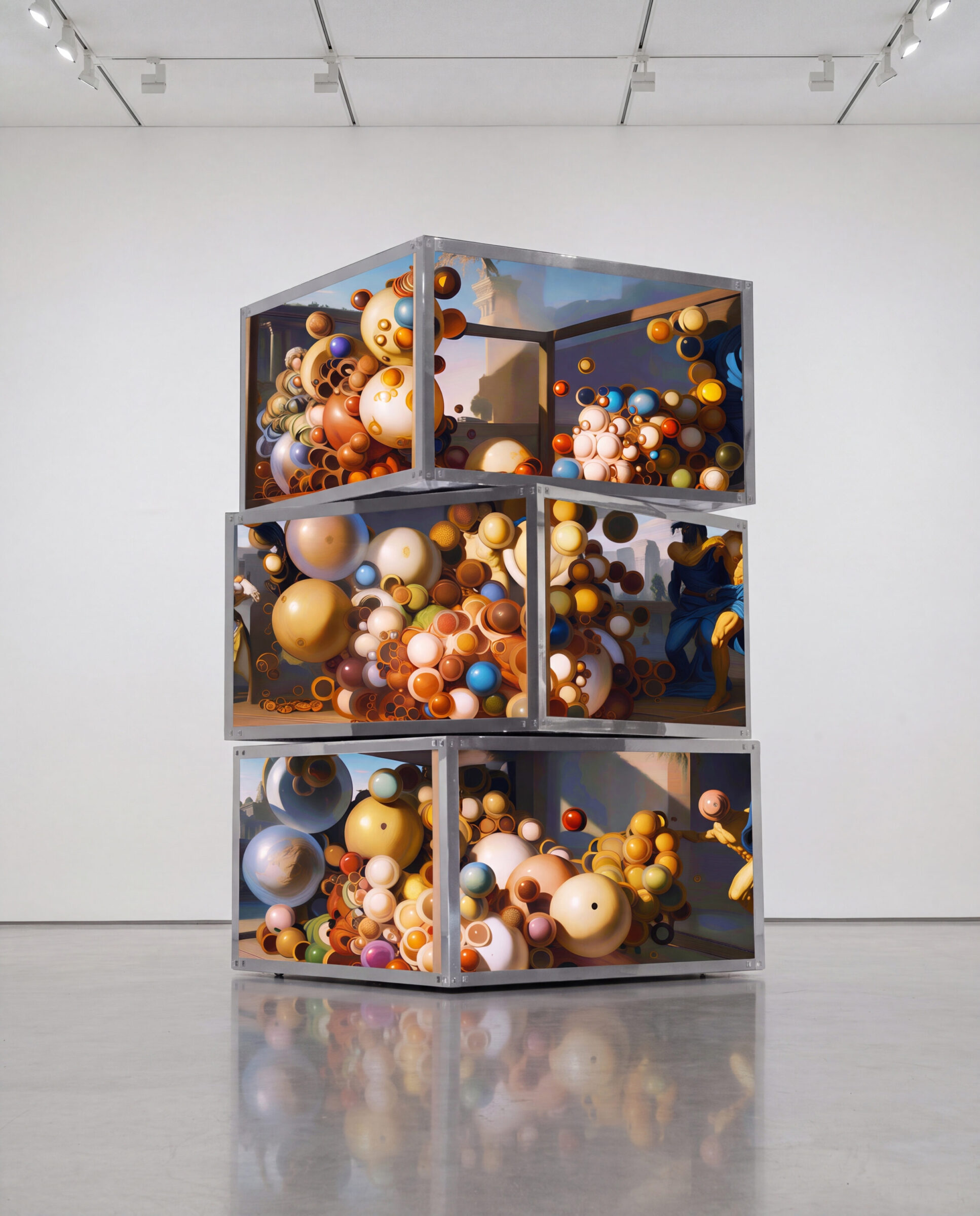
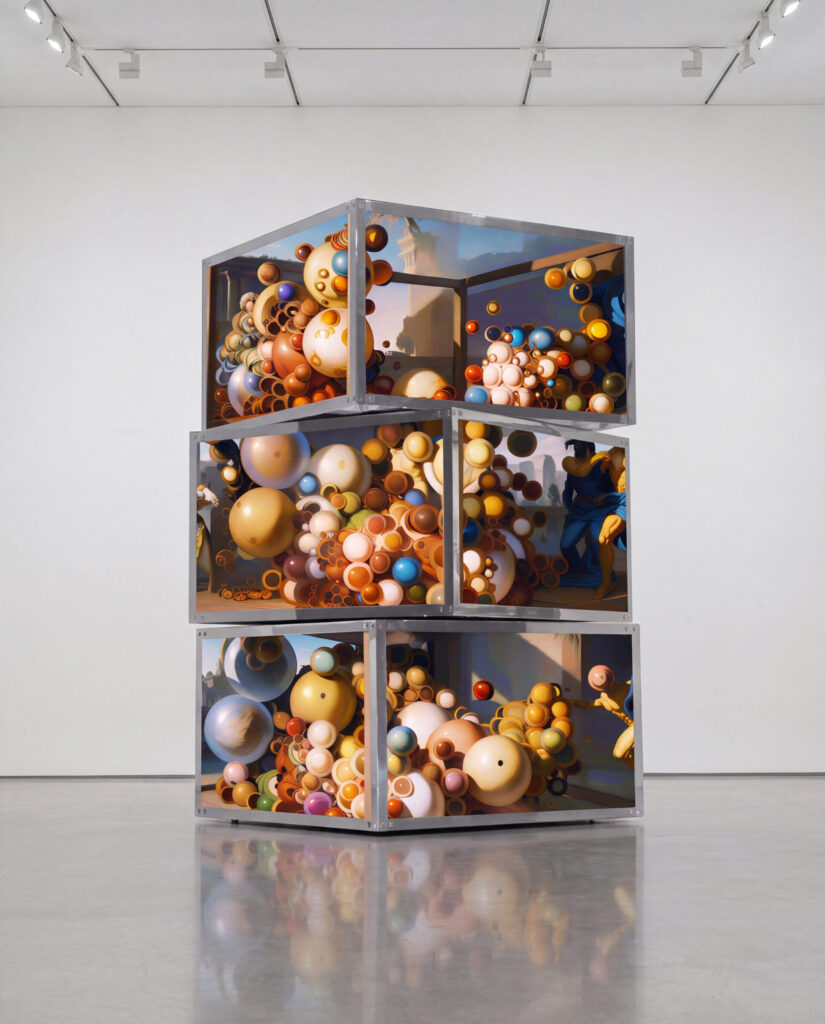
Opening Saturday, September 19, Diffuse Control is an interactive kinetic video sculpture composed of twelve synchronized screens. The installation combines generative AI, custom software, works selected from MMoCA’s permanent collection, and audience participation through a control kiosk.
The work raises many of the same questions surrounding generative AI today: Who owns an AI-assisted work? Who controls it? Are those even the same question? How are AI systems trained? Did the creators of the source material consent? And what responsibility do artists and institutions have when working with these technologies?
One important distinction is that not all AI systems work the same way.
Many familiar generative AI platforms are cloud-based, meaning they operate through remote servers and can be accessed by large numbers of users online. Much of the controversy surrounding these systems centers on the enormous datasets used to develop them and questions around consent, copyright, attribution, and compensation.
Diffuse Control operates differently. The installation uses Stable Diffusion within a closed, locally controlled environment rather than as an open cloud-based image-generation service. Images from MMoCA’s collection are introduced locally into the installation and, according to the museum, are not added to Stable Diffusion’s original training data or contributed to another
public AI dataset.
That does not resolve every ethical question surrounding generative AI. The underlying technology still exists within a much larger and more controversial AI ecosystem. But it does create an important distinction between using AI within a controlled artistic environment and placing artwork into a publicly accessible system where its use may be harder to track or control.
MMoCA has also stated that the collection images used are either in the public domain or used with permission from the appropriate copyright holder. Still, legality does not entirely settle the ethical question. For artists who died long before AI existed, we can never know how they would feel about seeing their work incorporated into a system like this.
That tension is not entirely new. Artists’ work has long been reproduced, reinterpreted, commercialized, and transformed through changing technologies. AI has made the conversation considerably more urgent and relevant.
Then comes perhaps the biggest question: Is it art?
In many ways, the title Diffuse Control speaks directly to that uncertainty. Control is distributed between Beeple, the museum, participating artists, visitors, source imagery, and the machine itself. No single participant completely determines the final result.
That makes Diffuse Control a fitting reflection of the broader moment we are entering with AI, one defined by increasingly blurred boundaries around authorship, ownership, responsibility, and creative agency.
Whether Diffuse Control should be considered “Art” with a capital A—and what role Beeple, the machine, the museum, the participating artists, and the audience each play in creating it—is ultimately a question viewers will have to grapple with themselves.
And perhaps that is precisely the point. We encourage readers to experience Diffuse Control firsthand and make their own conclusions.